Age vs. AMH: The Critical Difference Between Egg Quantity and Egg Quality
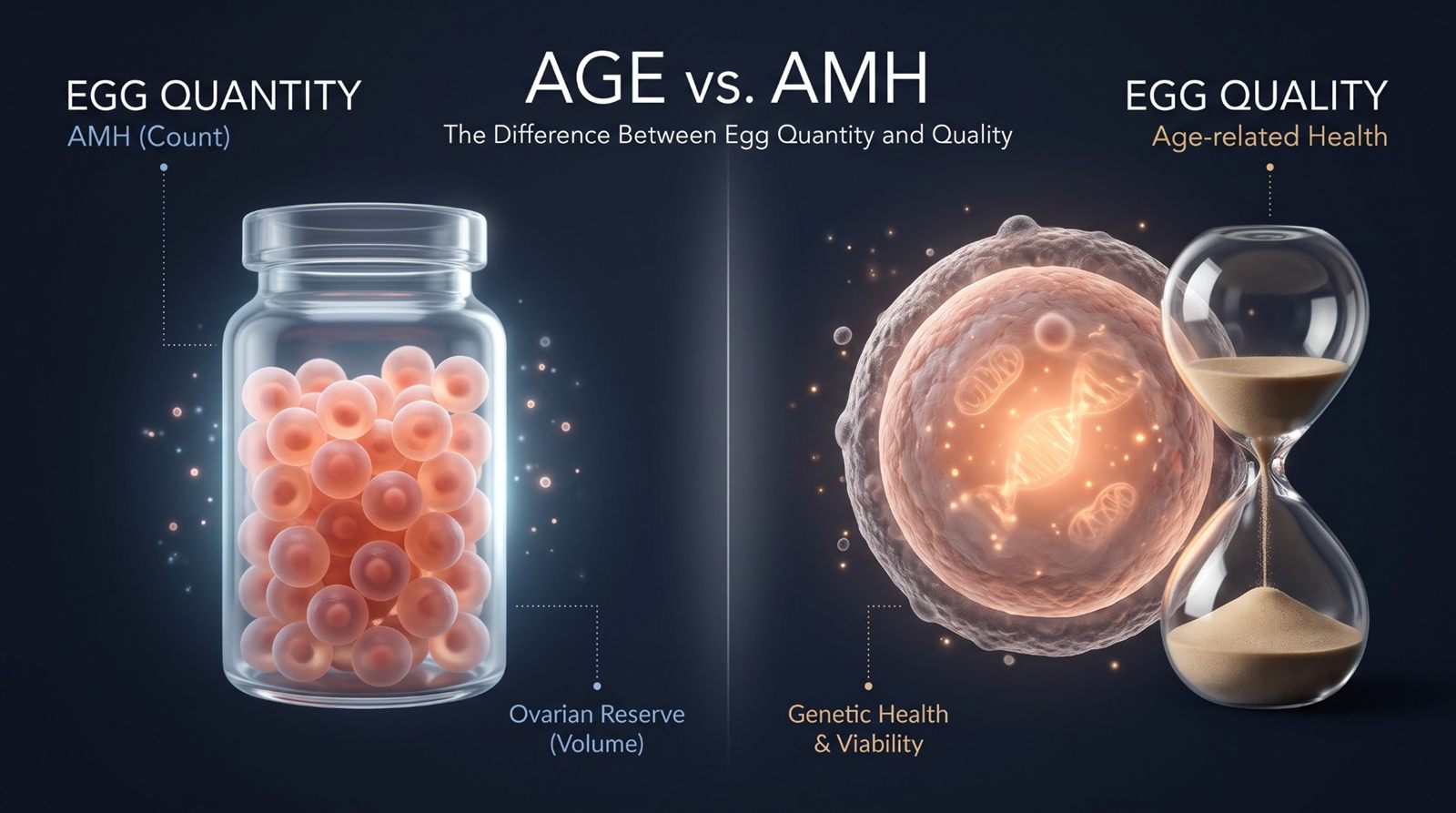
“But my AMH is high, shouldn’t IVF success be easy for me?” This is one of the most common questions we hear during initial fertility consultations. It is incredibly tempting to confuse egg quantity with egg quality, but clinically, they mean very different things. While Anti-Müllerian Hormone (AMH) is a highly useful clinical marker that tells us how many eggs you have left in reserve, it tells us absolutely nothing about the genetic health of those eggs.
Understanding the distinct, separate roles that your AMH and your biological age play is essential for setting realistic expectations and predicting the outcome of an IVF cycle. Relying solely on a high AMH level can lead to unexpected disappointment if age-related quality issues are not taken into consideration.
What AMH Actually Tells Us
- Medication Dosing and Protocol Strategy: AMH is a hormone secreted by the small, resting follicles in your ovaries. This number helps your reproductive endocrinologist determine how vigorously your ovaries will respond to stimulation medications. It directly dictates the dosage and protocol we select to safely maximize your egg yield without putting you at risk for conditions like Ovarian Hyperstimulation Syndrome (OHSS).
- Predicting Egg Yield: A higher AMH generally predicts a higher number of eggs retrieved during the surgical procedure. It gives the embryology lab more “opportunities” to work with. If you have a high AMH, we expect more eggs to enter the top of the “IVF funnel.”
Why Age Dictates Quality
- The Euploid Rate (Genetic Normalcy): As women age, the DNA and mitochondria inside their eggs become increasingly prone to errors. The spindle apparatus—the biological machinery responsible for dividing chromosomes correctly—begins to degrade. This leads to a much higher rate of aneuploidy (chromosomal abnormalities). No matter how many eggs you have retrieved, age dictates the percentage of those eggs that are genetically normal.
- The Clinical Reality: Consider two patients: a 30-year-old and a 40-year-old. Both might have the exact same AMH level and retrieve exactly 10 eggs. However, statistically, the 30-year-old will have a significantly higher percentage of genetically normal (euploid) embryos capable of creating a healthy pregnancy, while the 40-year-old may only yield one or even zero euploid embryos from that same cohort of 10 eggs.
Predicting IVF Success Rates
A high AMH level confers an excellent clinical advantage because it allows us to recruit a strong cohort of eggs to fertilize. However, biological age definitively remains the primary factor in predicting the genetic health, implantation potential, and viability of the resulting embryos. By evaluating both parameters together, we can provide you with a highly accurate, personalized roadmap for your fertility journey.
You Are Not Alone. Our team is ready to help you!
We will assist you in every possible way to have a positive and successful experience as you proceed along your reproductive journey. Whether you desire a second opinion, or this is your very first visit to a fertility center, you can get started by scheduling an appointment today!

Request Your Appointment!
What our patients are saying

Dr. Qasim and his team are the best. They are very sensitive to their patients' feelings and problems. They helped me throughout the entire process and gave me so much strength when I needed it. My husband and I are currently 12 weeks pregnant, and we are the happiest. Dr. Qasim, thank you so much. May God bless you always.
Grecia C.
We can't express enough how grateful we are for the support and expertise we received from Dr. Rahul Sachdev and his team along our nurse Victoria from the very first consultation he and the team made us feel understood and cared for. They guided us through each step of the process with compassion and professionalism always taking the time to answer our questions and address my concerns.
Navi S.
5 weeks ago I delivered my IVF baby. I can't thank Dr. Sachdev enough for his knowledge and being straight forward with everything. The team was great as well. Thank you for my blessing 💕
Jennifer M.

Edison, NJ
CENTER FOR ADVANCED REPRODUCTIVE MEDICINE & FERTILITY
4 Ethel Rd, Edison, NJ 08817
Princeton, NJ
CENTER FOR ADVANCED REPRODUCTIVE MEDICINE & FERTILITY
114 Stanhope St, Princeton, NJ 08540
Cranford, NJ
CENTER FOR ADVANCED REPRODUCTIVE MEDICINE & FERTILITY
123 N Union Ave #102, Cranford, NJ 07016