Understanding the IVF Attrition Rate: Why Every Egg Doesn’t Become an Embryo
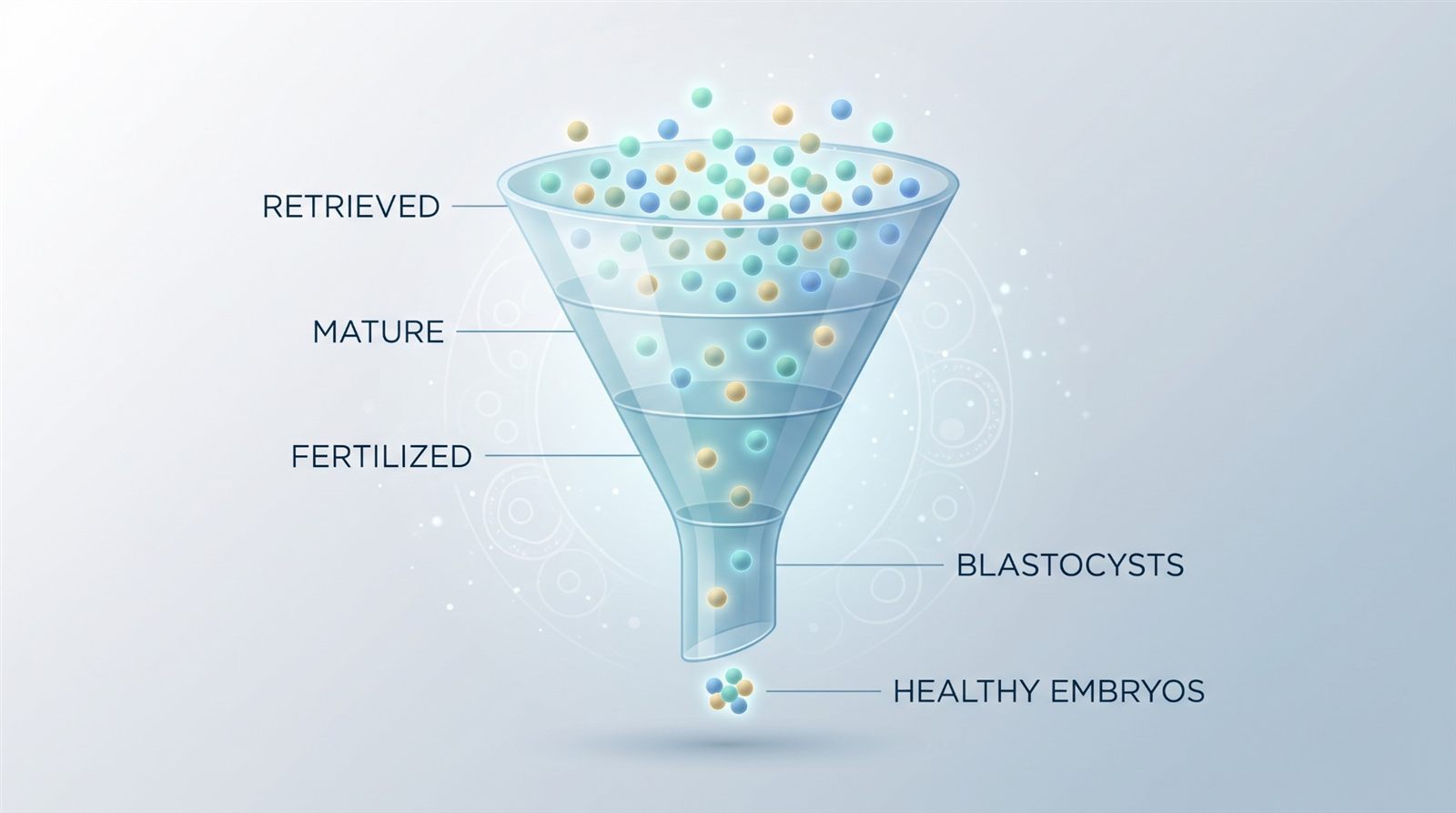
One of the most emotionally challenging aspects of the IVF process is watching the numbers drop. Patients are often shocked and disheartened when they wake up from an egg retrieval procedure to learn that 15 eggs were retrieved, only to find out a week later that they have just 3 or 4 healthy embryos available for transfer. This steep decline is completely normal and clinically expected in almost every IVF cycle. We call this the “IVF Attrition Rate” or the “IVF Funnel.”
Understanding this biological reality before you begin your cycle is crucial for preparing for your IVF outcomes and maintaining your peace of mind. The drop in numbers does not mean that you have done anything wrong, nor does it indicate a failure on the part of your clinical team or the embryology lab. Instead, it is a natural biological filtration process. Here is a clinical breakdown of exactly where and why the numbers decrease at each stage of the funnel.
The Stages of Attrition
- Retrieved vs. Mature: The first drop occurs immediately after your retrieval. Not all retrieved eggs are mature. In a normal cycle, we expect about 75% to 80% of the retrieved eggs to be in the mature “MII” stage. Only mature eggs have completed the necessary cellular division to accept sperm and fertilize. Any immature eggs (GV or MI stage) cannot be safely fertilized at that stage and are usually discarded unless they (occasionally) progressively mature in the lab.
- Fertilization Rates: Once we have the mature eggs, our embryologists will introduce the sperm, often using a highly precise method called ICSI (Intracytoplasmic Sperm Injection). Even with this advanced technique—where a single healthy sperm is injected directly into the egg—not every mature egg will successfully fertilize. A 70% to 80% fertilization rate is standard and considered excellent in the lab. Sometimes, the egg simply lacks the internal energy to combine its DNA with the sperm.
- Blastocyst Development: The biggest and most notorious clinical drop-off happens between Day 3 and Day 5 of development in the incubator. For the first three days, the embryo relies entirely on maternal energy (from the egg). On Day 3, the embryo’s own newly formed DNA takes over. If there are genetic errors, the embryo will stop growing. Only the most genetically robust embryos possess the cellular energy to reach the complex, hundreds-of-cells blastocyst stage. Expect about 40% to 60% of your fertilized eggs to make it to this milestone.
- Chromosomal Integrity: Once the embryos reach the blastocyst stage, the vast majority of patients elect to undergo chromosomal screening, or PGT-A (Preimplantation Genetic Testing for Aneuploidy), of these embryos to maximize their prognosis for a healthy baby. Depending on multiple patient factors, including age and ovarian reserve, approximately 50% of embryos tested would return as normal (euploid). However, this yield varies significantly among individuals; for example, in women ages 41 and above, the number ranges from 12% to 25% at most, regardless of how optimal the embryo may appear.
Clinical Expectations for IVF Success
By understanding the IVF funnel, patients can view this process through a more clinical, data-driven lens. A drop in numbers is the body and the lab working together to filter out embryos that were never going to result in a healthy pregnancy. The ultimate goal of an IVF cycle is not to end up with scores of frozen embryos; rather, it is to uncover the genetically competent ones capable of resulting in a single, healthy baby at a time.
You Are Not Alone. Our team is ready to help you!
We will assist you in every possible way to have a positive and successful experience as you proceed along your reproductive journey. Whether you desire a second opinion, or this is your very first visit to a fertility center, you can get started by scheduling an appointment today!

Request Your Appointment!
What our patients are saying

Dr. Qasim and his team are the best. They are very sensitive to their patients' feelings and problems. They helped me throughout the entire process and gave me so much strength when I needed it. My husband and I are currently 12 weeks pregnant, and we are the happiest. Dr. Qasim, thank you so much. May God bless you always.
Grecia C.
We can't express enough how grateful we are for the support and expertise we received from Dr. Rahul Sachdev and his team along our nurse Victoria from the very first consultation he and the team made us feel understood and cared for. They guided us through each step of the process with compassion and professionalism always taking the time to answer our questions and address my concerns.
Navi S.
5 weeks ago I delivered my IVF baby. I can't thank Dr. Sachdev enough for his knowledge and being straight forward with everything. The team was great as well. Thank you for my blessing 💕
Jennifer M.

Edison, NJ
CENTER FOR ADVANCED REPRODUCTIVE MEDICINE & FERTILITY
4 Ethel Rd, Edison, NJ 08817
Princeton, NJ
CENTER FOR ADVANCED REPRODUCTIVE MEDICINE & FERTILITY
114 Stanhope St, Princeton, NJ 08540
Cranford, NJ
CENTER FOR ADVANCED REPRODUCTIVE MEDICINE & FERTILITY
123 N Union Ave #102, Cranford, NJ 07016